| Specification | Description |
|---|---|
|
Product Name |
Sulfur WDG |
|
Chemical Composition |
Elemental Sulfur |
|
Physical Form |
Water-Dispersible Granules |
|
Color |
Yellow |
|
Primary Application |
Agriculture |
|
Typical Sulfur Content |
80% (depending on formulation) |
|
Packaging |
Available according to customer requirements |
|
Storage Conditions |
Store in a cool, dry, well-ventilated area |
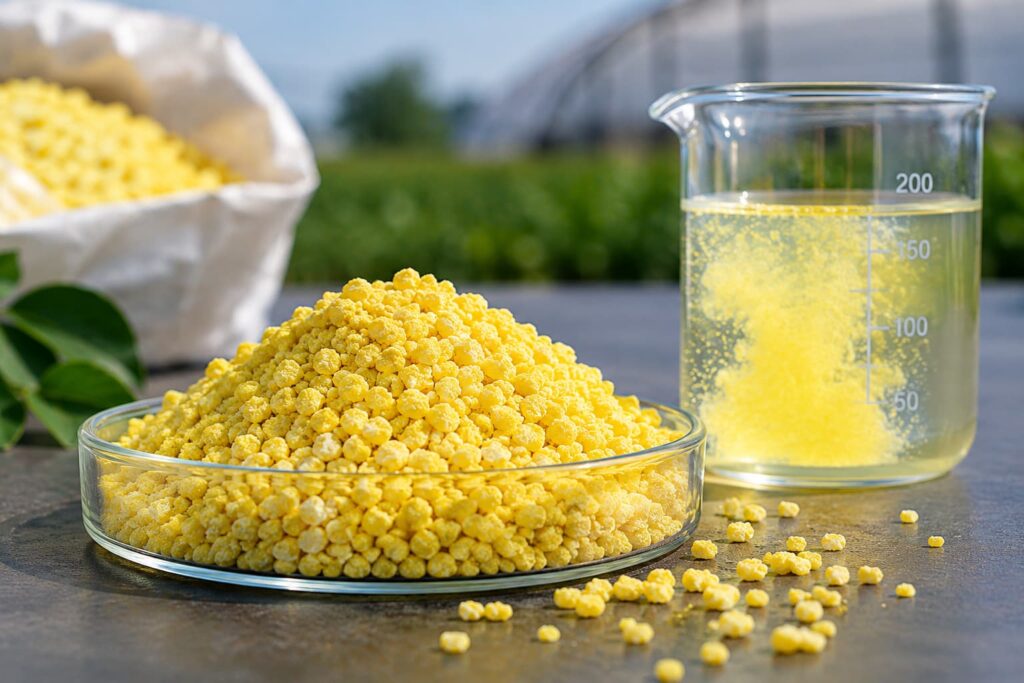
Sulfur WDG (Water-Dispersible Granules) is an advanced sulfur-based formulation developed primarily for agricultural applications. It contains elemental sulfur in a specially formulated granular form designed to disperse readily in water, allowing for convenient handling, preparation, and application.
Unlike conventional sulfur powders, WDG formulations are designed to reduce dust formation during handling and improve the ease of measuring, mixing, and distributing the product. When mixed with water according to the product instructions, the granules break apart and disperse throughout the liquid, creating a suspension suitable for appropriate agricultural application equipment.
Sulfur WDG combines the established agricultural value of elemental sulfur with formulation technology designed to support efficient application, improved handling, and consistent product performance.
The principal active component of Sulfur WDG is elemental sulfur. The formulation may also contain dispersing agents, wetting agents, binders, and other formulation aids that help the granules maintain their physical integrity during storage and disperse when added to water.
Typical physical and chemical characteristics may include:
Chemical name: Elemental sulfur
Chemical symbol: S
Molecular formula: S₈, the common molecular form of elemental sulfur
CAS number: 7704-34-9
Physical form: Water-dispersible granules
Typical color: Yellow
Primary application: Agriculture
Application method: Water-based suspension, where permitted by the product label
Sulfur concentration: Formulation-dependent; 80% is a common commercial grade
Actual sulfur concentration, particle size, moisture content, pH, dispersion performance, and other specifications depend on the manufacturer’s formulation and should be confirmed through the product’s technical data sheet (TDS) and certificate of analysis (COA).
One of the principal advantages of WDG technology is its granular physical form. Compared with many conventional fine sulfur powders, properly formulated granules can generate less dust during handling, weighing, and preparation. This can improve convenience for operators and help reduce airborne product during routine handling, although appropriate protective equipment remains necessary.
Sulfur WDG is designed to break apart and disperse in water. This allows users to prepare an application suspension without handling the same quantity of loose fine powder directly. Good dispersion can help distribute the active ingredient more evenly when the product is prepared and applied according to its instructions.
It is important to distinguish dispersion from dissolution: elemental sulfur does not simply dissolve in water. Instead, the granules disintegrate into smaller particles that remain suspended in the liquid.
The granular formulation can simplify measuring, transportation, storage, and preparation for agricultural use. When the formulation is compatible with the application equipment and used correctly, it can support practical and uniform distribution across the intended treatment area.
Granular products are generally easier to handle than highly dusty powders. However, storage stability depends on formulation quality, packaging, moisture exposure, temperature, and storage duration. Products should always be stored according to the manufacturer’s recommendations.
Elemental sulfur has a long history of agricultural use. Depending on the formulation, crop, target organism, and approved label, sulfur-based products may contribute to plant sulfur nutrition and help manage certain fungal diseases and mites.
Sulfur WDG is primarily developed for agricultural use. Its suitability for a particular crop or application depends on its sulfur concentration, formulation, local regulations, and the manufacturer’s approved directions.
Sulfur is an essential plant nutrient required for normal growth and metabolism. It contributes to the formation of sulfur-containing amino acids, proteins, and enzymes, and plays a role in several important plant processes.
In sulfur-deficient soils or cropping systems, suitable sulfur fertilizers can help correct nutrient deficiencies and support healthy crop development. However, the effectiveness of Sulfur WDG as a nutritional product depends on its formulation, application method, and the availability of sulfur to the plant.
Some sulfur formulations are used as contact fungicides to help manage specified fungal diseases. Their effectiveness depends on the crop, disease, environmental conditions, application timing, and product formulation.
Sulfur WDG should only be used for disease management when the product is registered and labeled for the intended crop and target disease.
Certain agricultural sulfur products may also be used to help control specified mite pests. Performance depends on the target species, crop conditions, temperature, application coverage, and approved directions.
Not every sulfur formulation is approved or equally suitable for all these purposes. Users should consult the product label before selecting an application.
The performance of Sulfur WDG is influenced by both the properties of elemental sulfur and the characteristics of its formulation.
During preparation, the granules disintegrate in water and disperse into smaller particles. Appropriate wetting and dispersing agents can help the particles distribute through the liquid and remain suspended long enough for application.
For products intended for foliar disease or pest management, the sulfur particles are deposited on plant surfaces. Their activity depends on the specific formulation, target organism, environmental conditions, and coverage achieved during application.
For nutritional use, the availability of sulfur depends on how the product is formulated and how the sulfur becomes accessible within the growing environment. Elemental sulfur generally requires microbial oxidation to sulfate before plants can absorb it efficiently through their roots. Consequently, elemental sulfur should not be assumed to provide the same immediate nutritional availability as sulfate-based fertilizers.
Feature | Sulfur WDG | Conventional Sulfur Powder |
|---|---|---|
Physical form | Water-dispersible granules | Fine powder |
Dust generation | Generally lower during handling | Can be relatively high |
Water preparation | Granules disintegrate and disperse | Fine powder must be properly wetted and dispersed |
Handling | Convenient granular form | May require greater care to minimize dust |
Application | Suitable for labeled water-based applications | Depends on the specific powder formulation |
Storage | Sensitive to formulation and moisture conditions | Sensitive to packaging and storage conditions |
Composition | Elemental sulfur plus formulation aids, where used | Usually elemental sulfur, with composition depending on grade |
The key distinction is the formulation rather than the sulfur element itself. WDG technology is intended to improve handling and water dispersion; it does not automatically mean that the product contains more sulfur or provides better biological performance than every conventional sulfur product.
For products intended for water-based agricultural application, the manufacturer’s directions should be followed carefully.
General considerations include:
Use clean water and suitable application equipment.
Follow the label’s recommended mixing sequence and agitation requirements.
Maintain adequate agitation where necessary to keep particles evenly suspended.
Apply only at the recommended rate and interval for the specified crop and target.
Check compatibility before mixing with other agricultural products.
Avoid unauthorized combinations that may affect product stability, crop safety, or efficacy.
Clean application equipment according to the product instructions after use.
Sulfur products can cause crop injury under certain conditions, particularly with sensitive crops, high temperatures, or incompatible mixtures. Some sulfur formulations are also incompatible with oils or applications made too close to oil treatments. Always follow the specific label’s restrictions and safety guidance.
The quality of Sulfur WDG depends on more than its declared sulfur concentration. Important quality parameters may include:
Parameter | Why It Matters |
|---|---|
Sulfur content (%) | Indicates the proportion of elemental sulfur in the formulation |
Appearance and color | Helps assess consistency with the product specification |
Granule size | Influences handling and physical characteristics |
Dispersibility | Indicates how readily granules disperse in water |
Wetting performance | Affects how the formulation interacts with water |
Suspensibility | Indicates the ability of dispersed particles to remain suspended |
Moisture content | Can affect granule stability and storage |
Storage stability | Helps assess whether the product maintains its properties over time |
Packaging integrity | Helps protect the product from moisture and contamination |
These parameters should be evaluated against the manufacturer’s specifications and applicable product standards. Exact numerical limits should not be published unless supported by verified test results.
Sulfur WDG may be supplied in packaging formats selected according to the manufacturer’s offering and customer requirements. Packaging should protect the granules against moisture, contamination, and physical damage during transportation and storage.
For storage:
Keep the product in its original, properly sealed packaging.
Store it in a cool, dry, well-ventilated location.
Protect it from moisture and excessive heat.
Keep it away from incompatible materials and sources of ignition, following the safety data sheet (SDS).
Prevent unauthorized access and keep the product away from food, animal feed, and drinking water.
Follow all handling and disposal instructions provided by the manufacturer.
Although granular formulations can reduce dust during routine handling, sulfur-containing products still require appropriate precautions. Consult the SDS for personal protective equipment, spill response, fire precautions, and disposal requirements.
Sulfur is an important agricultural nutrient, and appropriate sulfur management can contribute to balanced crop nutrition. Applying sulfur products according to crop requirements can help address deficiencies and support efficient nutrient management.
However, environmental performance depends on the formulation, application rate, soil and water conditions, crop requirements, and handling practices. Excessive or inappropriate application may cause undesirable effects, including changes in soil chemistry or risks to non-target organisms.
Responsible use therefore requires appropriate product selection, accurate application, compliance with local regulations, and adherence to the manufacturer’s technical guidance.
At PetroSulfur, the development of sulfur-based products can be positioned around reliable quality, practical application, and responsible resource utilization. A high-quality Sulfur WDG product should combine a consistent elemental sulfur content with granule integrity, suitable water dispersion, and dependable performance under its intended conditions of use.
PetroSulfur’s product offering can emphasize:
Quality-focused manufacturing: Attention to product consistency and defined specifications.
Formulation performance: Focus on granule stability, wetting, and dispersion characteristics.
Practical handling: A granular format designed to simplify routine handling and preparation.
Agricultural versatility: Potential use in approved nutritional or crop-protection applications, depending on the specific formulation.
Technical documentation: Product specifications, safety information, and quality documentation appropriate to the supplied grade.
Customer-focused supply: Packaging and supply arrangements based on actual product availability and customer requirements.
Any claims about PetroSulfur’s manufacturing technology, certifications, testing facilities, or product performance should be supported by verified company information and test documentation.
Sulfur WDG represents a practical development in sulfur formulation technology, combining elemental sulfur with a granular structure designed for dispersion in water. Its principal advantages include convenient handling, reduced dust formation compared with many fine powders, and suitability for specified agricultural applications.
When manufactured to consistent specifications and used according to its approved instructions, Sulfur WDG can provide a useful option for agricultural sulfur delivery and, where the formulation is registered for the purpose, selected crop-protection applications.
For professional purchasing and application decisions, buyers should verify the sulfur concentration, dispersibility, physical specifications, packaging, safety documentation, and intended use through the manufacturer’s technical data sheet and certificate of analysis.